
 Available in US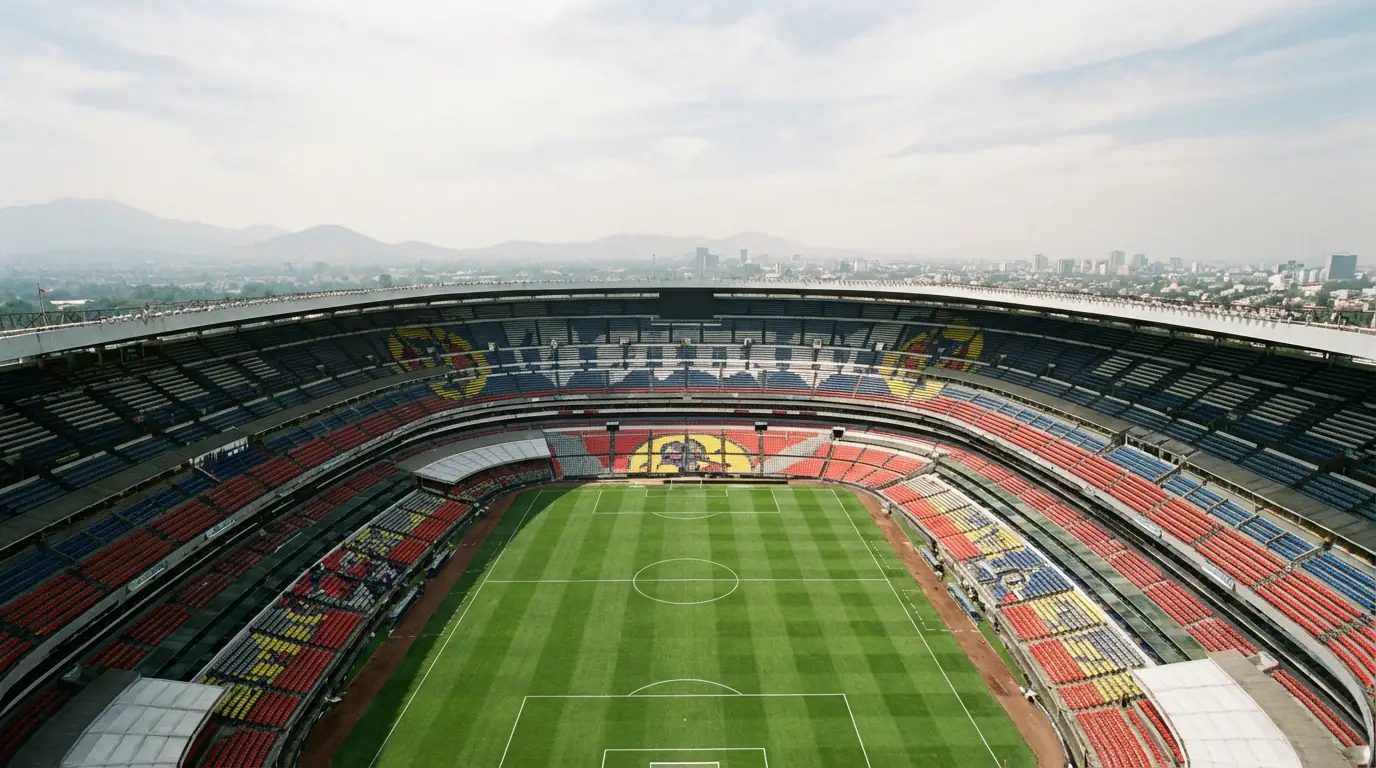
There is a photograph from the 1986 World Cup quarter-final at the Estadio Azteca that shows Diego Maradona mid-stride, five English defenders trailing behind him, 114,000 people on their feet. That image — frozen in the thin air of Mexico City — captures what the Azteca means to world football. No other stadium on the planet has hosted two World Cup finals. No other ground carries the weight of Pelé’s coronation in 1970 and Maradona’s coronation in 1986. On 11 June 2026, the Estadio Azteca adds another chapter to its legend: the opening match of the first 48-team World Cup, Mexico vs South Africa, in a city that sits 2,200 metres above sea level.
About Estadio Azteca
The Estadio Azteca opened on 29 May 1966, built specifically to host the 1970 World Cup. Designed by architects Pedro Ramírez Vázquez and Rafael Mijares Alcérreca, the stadium was a marvel of mid-century engineering — a vast concrete bowl carved into the volcanic landscape of the Tlalpan district in southern Mexico City. The original capacity exceeded 100,000, making it the largest stadium in the Americas at the time of its construction.
For the 2026 World Cup, the Azteca’s capacity has been reduced to approximately 83,000 following extensive renovations that began in 2022. The upgrade programme replaced the original seating, improved accessibility, modernised the concourse areas, and installed new floodlighting systems that meet FIFA’s current broadcast standards. The playing surface is natural grass, maintained under challenging conditions — the combination of Mexico City’s altitude, air quality, and intense summer rainfall creates a microclimate that requires constant pitch management. The surface at the Azteca has historically been criticised as uneven and slow, but the renovation programme has addressed drainage and levelling issues that plagued earlier tournaments.
The stadium’s location in the southern part of Mexico City means that visiting teams face a journey of approximately 45 minutes from the city centre, depending on traffic conditions. Mexico City’s traffic is legendary — among the worst in the world — and match-day logistics at the Azteca require careful planning. The nearest metro station, Estadio Azteca on Line 12, provides direct access, and FIFA’s transport plan for the tournament includes dedicated shuttle services from designated fan zones in the city centre.
World Cup 2026 Matches at the Azteca
The Estadio Azteca will host the tournament’s opening match on 11 June 2026: Mexico vs South Africa. The symbolism is deliberate — FIFA awarded the opener to Mexico City as an acknowledgement of the Azteca’s unmatched World Cup heritage, and the fixture against South Africa echoes the 2010 World Cup opener in Johannesburg. The match will kick off in the early evening local time, which translates to approximately 23:00 or midnight IST, depending on the final scheduling confirmation.
Beyond the opener, the Azteca is expected to host several group-stage matches and at least one Round of 32 fixture. The exact allocation has not been finalised, but Mexico City’s status as one of three host nations guarantees that the Azteca will feature prominently in the tournament schedule. The atmosphere for Mexico’s group matches will be extraordinary — Mexican football fans are among the most passionate in the world, and the Azteca in full voice produces a wall of sound that visiting teams find deeply unsettling.
From a betting perspective, the home advantage for Mexico at the Azteca is one of the strongest in international football. Mexico’s record at the Azteca in competitive matches is formidable — they rarely lose at home, and the altitude factor plays a significant role in undermining visiting teams’ physical performance. I factor altitude into every match price at the Azteca, and I recommend you do the same.
A Cathedral of Football — The Azteca’s World Cup Legacy
The Estadio Azteca is the only stadium in the world to have hosted two World Cup finals. The 1970 final — Brazil 4-1 Italy — is widely regarded as one of the greatest matches in football history, and it was played on this pitch, in this thin air, in front of over 107,000 spectators. Pelé’s performance that day cemented his status as the greatest player of his era, and the Azteca was the stage that framed his masterpiece.
Sixteen years later, the 1986 World Cup returned to Mexico after Colombia withdrew as hosts. The Azteca hosted both the opening match and the final, and between those two fixtures, it witnessed Maradona’s “Hand of God” goal and “Goal of the Century” against England in the quarter-final — two moments that define World Cup history and both occurred within the same match, on the same pitch, in the same stadium. The final itself — Argentina 3-2 West Germany — was played in front of 114,600 spectators, a crowd that has never been matched at a World Cup final since.
The 2026 tournament makes the Azteca the first stadium to host three World Cups, though it will not host the final this time (that honour goes to MetLife Stadium in New Jersey). The opening match carries its own weight of history, and Mexico vs South Africa will be played with the ghosts of 1970 and 1986 hovering over every pass. For Irish fans old enough to remember Italia ’90 — when Mexico were eliminated in the Round of 16 by the same West Germany side that had lost the Azteca final four years earlier — the connections across World Cup history are vivid and personal.
The Altitude Factor — 2,200 Metres Above Sea Level
Altitude is not an abstract concept at the Estadio Azteca — it is a physical reality that affects every player on the pitch. At 2,200 metres above sea level, Mexico City’s atmospheric pressure is approximately 22% lower than at sea level, which means the air contains less oxygen per breath. For athletes performing at maximum intensity, the effects are measurable: reduced aerobic capacity, faster onset of fatigue, and longer recovery times between sprints. Teams based at sea level — which includes virtually every European and South American side — need a minimum of 3-5 days of acclimatisation to perform at their best, and even then, the final 20 minutes of matches at altitude produce noticeably more errors, slower pressing, and increased vulnerability from set pieces.
Mexico, by contrast, train and play at altitude regularly. The Azteca is their home ground, and the physiological adaptation that comes with growing up and training at 2,200 metres gives Mexican players a measurable advantage in the closing stages of matches. This is not speculation — the data supports it. Mexico’s win rate at the Azteca in competitive matches over the last 20 years is above 75%, and a significant portion of their goals are scored after the 70th minute, when visiting teams’ physical output drops.
For betting purposes, the altitude factor should influence your approach to every match at the Azteca. The over/under goals market is affected — matches at altitude tend to produce slightly more goals, partly because defensive concentration drops as fatigue sets in and partly because the ball travels faster and further through thinner air, making long-range shots and crosses more dangerous. The second-half goals market is particularly interesting at the Azteca, and I would weight my in-play betting toward the second half of any group-stage match played at this venue.
Mexico City as Host
Mexico City is one of the world’s great cities — a sprawling, chaotic, culturally rich metropolis of over 21 million people. For Irish fans considering a trip to the opening match, Mexico City offers an experience that is fundamentally different from the US host cities: the food is extraordinary, the history is layered and complex, the people are warm and welcoming, and the cost of living is significantly lower than New York, Boston, or Miami. A pint in a Mexico City bar costs a fraction of what you would pay in Manhattan, and the quality of street food — tacos, tortas, tamales — is world-class.
The city’s infrastructure for large-scale sporting events has been tested repeatedly. Mexico City hosted the 1968 Olympics, two World Cups, and regular Liga MX matches that draw crowds of 50,000-80,000 to the Azteca every fortnight. The metro system, while crowded, covers the city extensively, and ride-sharing services are reliable and affordable. The altitude is the one factor that visitors need to prepare for — take the first day easy, drink plenty of water, avoid heavy meals, and your body will adjust within 48-72 hours.
For a comprehensive look at every venue hosting matches during the tournament, the World Cup 2026 venues guide covers all 16 stadiums across the USA, Mexico, and Canada.
