
 Available in US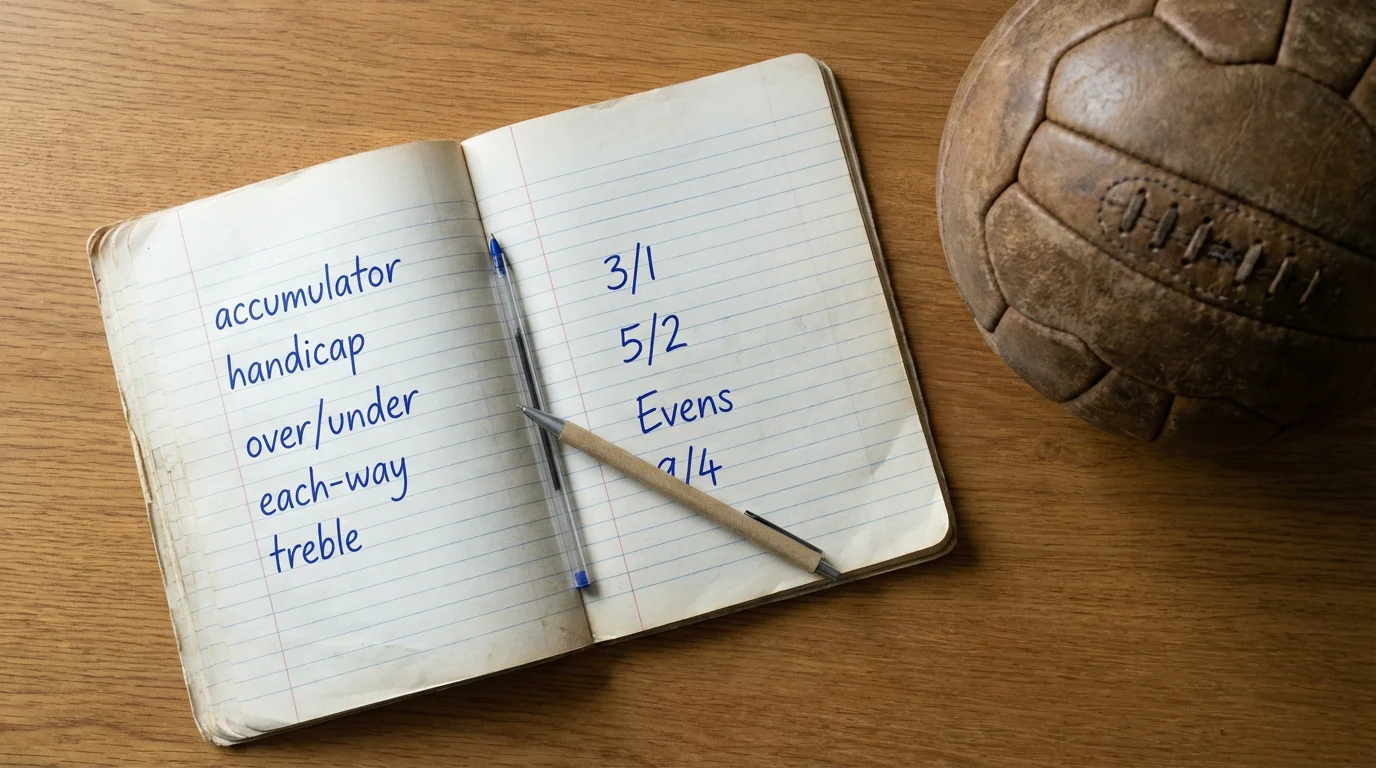
I once watched a new punter walk into a bookmaker’s, glance at the board, and walk straight back out. “I don’t speak that language,” he said. He wasn’t wrong — betting has its own vocabulary, and if you don’t know the difference between an accumulator and an Asian handicap, the markets might as well be written in code. This betting glossary covers 70 terms you’ll encounter during the 2026 World Cup, explained in plain English with examples drawn from the tournament itself. Keep it open on your phone when you’re building your first acca or navigating in-play markets at 2 a.m.
A–D
Accumulator (Acca) — A single bet combining multiple selections. All selections must win for the bet to pay out. The odds of each selection multiply together, creating high potential returns from small stakes. A four-fold accumulator backing four World Cup group-stage favourites at 4/6 each produces combined odds of roughly 7/1.
Added Time — Minutes added at the end of each half to compensate for stoppages. Also called injury time or stoppage time. Bets on match result typically include added time but exclude extra time. The 2022 World Cup featured unusually long added-time periods, with several first halves running past the 50th minute.
Ante-Post — A bet placed well before an event begins, typically weeks or months in advance. Ante-post World Cup bets — such as outright winner markets placed in 2025 — usually offer longer odds than the same selections closer to the tournament, but they carry the risk that circumstances (injuries, squad changes) may alter a team’s prospects.
Asian Handicap — A handicap market that eliminates the draw by applying fractional advantages to one team. A -0.5 Asian handicap on England means they must win outright for the bet to succeed. A -1.5 handicap requires a two-goal victory. If the handicap is a whole number (e.g. -1) and the margin of victory matches exactly, the stake is refunded.
Bankroll — The total amount of money a punter has set aside for betting. Bankroll management involves allocating this sum across bets to minimise the risk of ruin. For the 2026 World Cup, a structured bankroll might allocate fixed percentages for pre-match, in-play, and outright bets across 39 days.
Bet Builder — A feature offered by most major bookmakers that allows you to combine multiple selections within a single match into one bet. You might back England to win, Harry Kane to score, and over 2.5 total goals in the same fixture. Also called “same game multi” or “request a bet” depending on the operator.
Both Teams to Score (BTTS) — A market where you bet on whether both teams in a match will score at least one goal each. A popular selection for World Cup group-stage accumulators, particularly in matches between two attacking sides where a clean sheet for either team is unlikely.
Bookie / Bookmaker — The company or individual offering the odds and accepting bets. In Ireland, major bookmakers include Paddy Power, BoyleSports, Ladbrokes Ireland, and Bet365. The term “turf accountant” is the formal equivalent, dating from the horse-racing tradition.
Cash Out — A feature that allows you to settle a bet before the event has concluded, locking in a profit or cutting a loss. During a World Cup match, you might cash out a winning in-play bet at half-time rather than risking a second-half reversal. The cash-out price offered by the bookmaker is typically lower than the fair value of the bet.
Correct Score — A bet on the exact final scoreline of a match. High odds because of the difficulty of predicting the precise outcome. The most commonly backed correct score in World Cup matches is 1-0, which occurs in approximately 15-18% of matches historically.
Dead Heat — When two or more selections tie in a market. In World Cup top-scorer betting, if two players finish level on goals, the Golden Boot is shared and payouts are divided by the number of tied selections. A €10 bet on a dead-heat winner would pay out half the full return.
Decimal Odds — An odds format that shows the total return per unit staked, including the stake. Decimal 3.00 means a €1 bet returns €3 (€2 profit plus €1 stake). Common on European betting platforms, though Irish punters traditionally prefer fractional odds.
Double — An accumulator with exactly two selections. Both must win for the bet to pay out. The simplest form of multiple betting and a good starting point for punters new to accumulators.
Draw No Bet (DNB) — A market where your stake is refunded if the match ends in a draw. You only win or lose based on which team wins outright. Useful for World Cup matches where you fancy a team to win but want insurance against the draw. The odds are shorter than the standard match-result price because the draw outcome is removed.
Drift — When odds lengthen (become less favourable to the bookmaker) over time. If England’s outright odds move from 5/1 to 6/1 in the weeks before the World Cup, they’ve drifted. A drift usually indicates that informed money isn’t backing the selection, or that negative news (injuries, poor form) has affected the market’s confidence.
E–L
Each-Way — A bet consisting of two parts: one on the selection to win, and one on the selection to place (finish in the top positions). In World Cup outright markets, each-way terms typically pay out if your team finishes in the top two or top four, at a fraction (usually 1/4 or 1/5) of the win odds. Each-way betting originates from horse racing but is widely applied to outright football markets.
Edge — The advantage a punter has over the bookmaker on a particular bet. If you assess a team’s true probability of winning at 40% but the odds imply only a 33% chance, you have an edge. Finding and exploiting edges consistently is the foundation of profitable betting.
Even Money (Evens) — Odds of 1/1. A €10 bet at evens returns €20 (€10 profit plus €10 stake). In decimal format, evens is 2.00.
Expected Goals (xG) — A statistical measure of the quality of chances created, based on factors like shot location, angle, and type. An xG of 2.3 means a team’s chances in a match were worth approximately 2.3 goals based on historical conversion rates. Widely used in pre-match analysis to assess whether a team is performing above or below expectation.
Favourite — The team or player most likely to win according to the odds. In a World Cup match between France and Iraq, France are the heavy favourite. The favourite’s odds are shorter (lower potential return per unit staked) than the underdog’s.
First Goalscorer — A bet on which player will score the first goal in a match. If your selected player doesn’t start, some bookmakers void the bet; others count it as a loss. Own goals typically don’t count for first-goalscorer purposes — the bet is settled on the next goal.
Fixed Odds — The odds at the time you place your bet are locked in, regardless of subsequent market movements. Most pre-match bets with bookmakers are fixed odds. If you back Argentina at 5/1 on Monday and the odds shorten to 4/1 by Wednesday, your bet still pays at 5/1.
Fold — The number of selections in an accumulator. A four-fold has four selections. A six-fold has six. The term is used exclusively in the context of multiples.
Fractional Odds — The traditional odds format in Ireland and the UK. Expressed as a fraction (5/1, 11/4, 4/7). The first number represents potential profit; the second is the stake. At 5/1, a €1 bet wins €5 profit. At 4/7, a €7 bet wins €4 profit.
Full-Time Result — The outcome of a match at the end of regular time (90 minutes plus added time). Does not include extra time or penalties. Also called “1X2” — 1 for home win, X for draw, 2 for away win.
Half-Time/Full-Time — A bet on the result at both half-time and full-time. For example, “Draw/Home” means the match is drawn at half-time and the home team wins at full-time. Higher odds because you’re predicting two outcomes, and the combinations involving scoreline reversals (e.g. Away/Home) pay the most.
Handicap — A market where one team is given a virtual advantage or disadvantage in goals. A -1 handicap on Brazil against Haiti means Brazil must win by two or more goals for the handicap bet to win. Handicap betting is useful in World Cup matches where the quality gap makes the standard result market uncompetitive.
Hedging — Placing additional bets to reduce potential losses or lock in profits from an earlier wager. If you’ve backed Argentina at 5/1 before the tournament and they reach the final, you might bet against them in the final to guarantee a profit regardless of the result.
Implied Probability — The probability of an outcome as suggested by the odds. Calculated by dividing the denominator by the sum of numerator and denominator in fractional odds. At 3/1, the implied probability is 1/(3+1) = 25%. The bookmaker’s margin means implied probabilities across all outcomes in a market sum to more than 100%.
In-Play (Live) Betting — Betting on a match while it’s being played. Odds update continuously based on the score, time elapsed, and match events. In-play markets for World Cup matches include next goal, match result, total goals, corners, cards, and player-specific props.
Lay — Betting against an outcome. Available on betting exchanges like Betfair. If you lay England to win, you profit if England draw or lose. Laying is the opposite of backing and is a fundamental concept in exchange betting.
Line — The specific number set by the bookmaker for a market. In an over/under 2.5 goals market, 2.5 is the line. In a handicap market, -1.5 is the line. The line is set to balance risk and attract betting on both sides.
Longshot — A selection at very long odds, considered unlikely to win. A team priced at 100/1 to win the World Cup is a longshot. Longshots offer enormous potential returns but win rarely enough that systematic backing is a losing strategy.
M–R
Margin (Overround) — The bookmaker’s built-in profit on a market. If the implied probabilities of all outcomes in a market sum to 105%, the 5% above 100% is the margin. Lower margins mean better value for the punter. The best bookmakers run World Cup match margins between 104% and 106%.
Match Result (1X2) — The most basic football betting market. Three possible outcomes: home win (1), draw (X), or away win (2). Settled at the end of regular time only.
Multiple — Any bet combining two or more selections. Accumulators, doubles, trebles, and yankees are all types of multiples.
Nap — A pundit’s or tipster’s strongest selection of the day. Comes from the card game Napoleon. “My nap for the World Cup opening day is France to beat Senegal” means that selection carries the highest confidence.
Odds-On — Odds shorter than even money, meaning you must stake more than you stand to win. At 4/7, you stake €7 to win €4 profit. Odds-on selections are considered likely to win. At the World Cup, most group-stage favourites are priced odds-on against weaker opponents.
Outright — A bet on the overall outcome of the tournament rather than individual matches. World Cup outright markets include tournament winner, group winner, top scorer, to reach the final, and continental performance markets.
Over/Under — A bet on whether the total number of goals (or corners, cards, etc.) in a match will be above or below a specified line. The standard line for World Cup matches is 2.5 goals. “Over 2.5” wins if three or more goals are scored; “under 2.5” wins if two or fewer goals are scored.
Patent — A bet consisting of seven wagers from three selections: three singles, three doubles, and one treble. More expensive than a treble but more resilient — you can profit with just one winning selection if the odds are long enough.
Price — Another word for odds. “What price is England to win the World Cup?” means “What odds are England at?”
Punt — An informal term for a bet, widely used in Ireland. “Having a punt on the World Cup” means placing bets on the tournament. A punter is someone who bets.
Push — When the result lands exactly on the line, and the bet is refunded. In an over/under 2.0 goals market, exactly two goals means the stake is returned. Also called a “void” in some contexts.
Return — The total amount received from a winning bet, including the original stake. A €10 bet at 3/1 returns €40 (€30 profit + €10 stake).
S–Z
Scorecast — A combined bet on the first goalscorer and the correct score. For example, Harry Kane to score first and England to win 2-0. High odds because both selections must be correct.
Shortening (Steaming) — When odds decrease, becoming less favourable to the bettor. If France’s outright odds move from 4/1 to 3/1, they’ve shortened. Shortening typically indicates heavy betting volume or positive news (e.g. a key player confirmed fit).
Single — A bet on one selection only. The simplest and most common form of betting. One team to win one match, one player to score, one outcome in one market.
Spread Betting — A form of betting where the payout depends on the accuracy of the wager rather than a fixed outcome. If the spread on total goals in a match is set at 2.5, and the match finishes 3-1, you win based on the four goals being 1.5 above the spread. Losses can exceed the initial stake, making spread betting higher-risk than fixed-odds betting.
Stake — The amount of money wagered on a bet. A €10 stake at 5/1 pays €60 (€50 profit + €10 stake returned).
Steam — A rapid, significant shortening of odds driven by heavy betting volume. When a selection steams, it indicates large sums of money backing it. Steam can be driven by insider knowledge, public sentiment, or syndicate activity.
Straight Forecast — A bet predicting the first and second-place finishers in a specific order. In World Cup group betting, a straight forecast might predict Brazil to finish first and Morocco to finish second in Group C. Both the positions and the teams must be correct.
Tip — A recommendation or suggestion for a bet. A “tipster” is someone who provides tips, usually based on analysis, form study, or claimed inside knowledge.
Treble — An accumulator with exactly three selections. All three must win for the bet to pay out.
Trixie — A bet consisting of four wagers from three selections: three doubles and one treble. Unlike a patent, a trixie does not include singles, so at least two selections must win to generate a return.
Underdog — The team or player least likely to win according to the odds. In a World Cup match between Brazil and Haiti, Haiti are the underdog. Underdogs offer longer odds (higher potential returns) but win less frequently.
Value — A bet where the odds offered are greater than the true probability of the outcome. If you believe a team has a 40% chance of winning but the odds imply only a 25% chance (3/1), the bet has value. Consistently finding value bets is the core skill of profitable punting.
Void — A bet that is cancelled and the stake refunded. Bets are typically voided if an event is postponed, a player doesn’t participate (in first-goalscorer markets), or the result falls on a push line.
Wager — A formal term for a bet. Used interchangeably with “bet,” “punt,” and “stake” in everyday Irish punting language.
Walkover — A result awarded to one team when their opponent cannot participate. Rare in World Cup contexts but technically possible if a team withdraws from the tournament.
Wincast — A combined bet on a player to score at any time and the match to finish with a specific result. Similar to a scorecast but without specifying when the goal is scored.
Yankee — A bet consisting of 11 wagers from four selections: six doubles, four trebles, and one four-fold. At least two selections must win to generate a return. Popular in Irish and British betting culture for matches where you have strong views on four outcomes but want some protection against one selection losing.
This glossary covers the vocabulary you’ll encounter across pre-match, in-play, and outright markets during the 2026 World Cup. The terms are the building blocks — the betting guide shows you how to put them together into a strategy that works across 39 days and 104 matches of tournament football.
