
 Available in US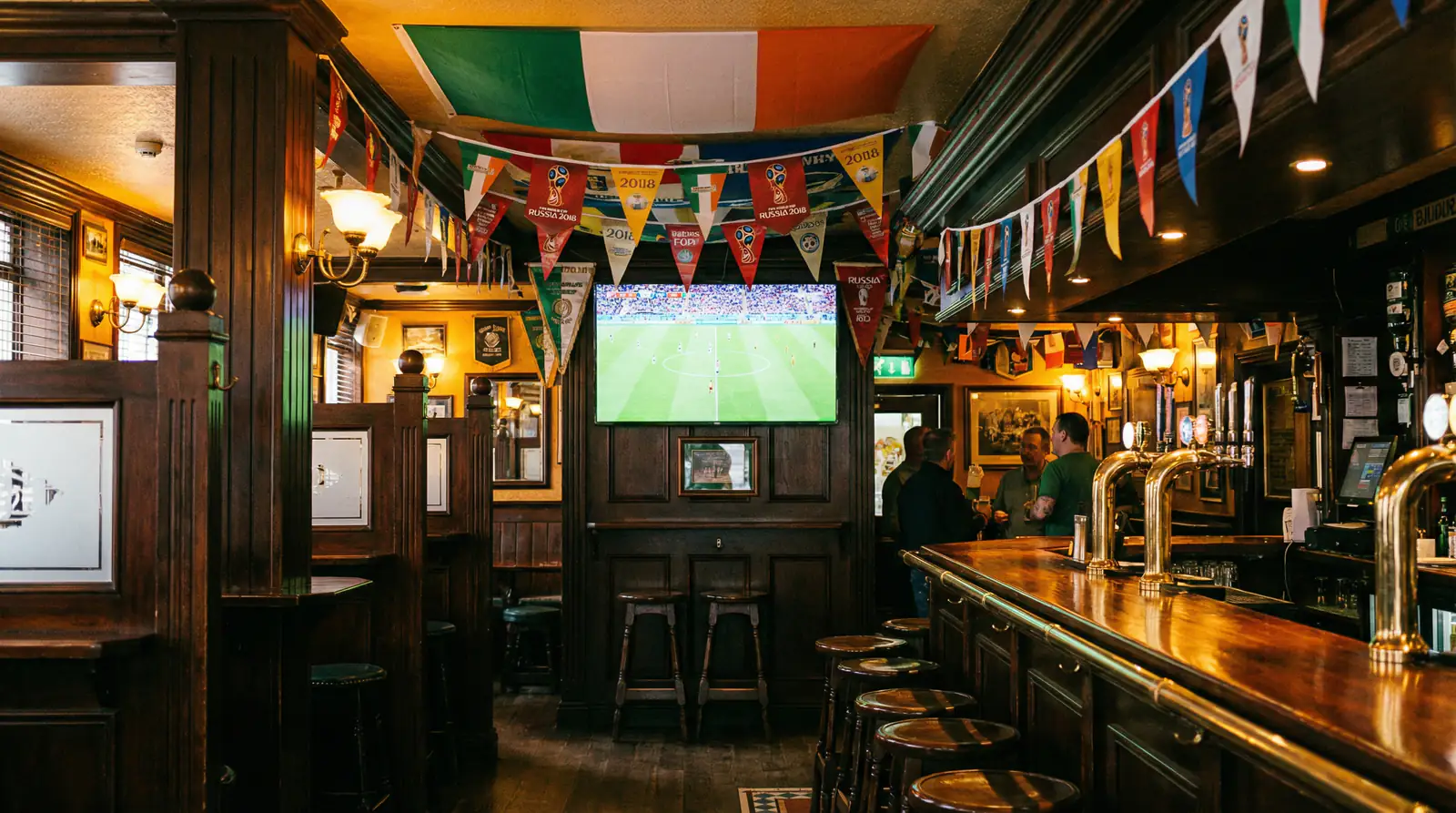
The penalty hit the post. Not saved — hit the post. That’s the difference between Ireland at the 2026 World Cup and Ireland watching the 2026 World Cup. In Prague on 26 March, the playoff semi-final against Czechia ended 2-2 after 90 minutes of football that swung between agony and ecstasy. Ireland equalised in the 87th minute — three minutes of genuine, chest-bursting hope that this generation would finally see the Boys in Green at a World Cup. Then the shootout. Then the fourth penalty. Then the post. And that was it.
If you’re Irish and you love football, the 2026 World Cup arrives carrying a very specific kind of grief. Not the dramatic grief of a tournament exit — we’d need to have been there for that. This is the grief of almost. The grief of watching from the outside again, knowing exactly how close it was and how long it might be before the next chance comes. But grief and football fandom have never been mutually exclusive in Ireland. We don’t stop watching because we’re not playing. We just redirect — fiercely, passionately, and with enough emotional investment to make you forget we’re technically neutrals.
What Happened — The Czechia Heartbreak
The road to Prague started in the autumn of 2024, when Ireland were drawn into qualifying Group F alongside Portugal, Sweden, and two sides they were expected to beat. The reality was messier. Portugal were dominant, losing just once across ten matches and qualifying with room to spare. Ireland finished second — a significant achievement against Sweden and the lower-ranked opponents — but second meant the playoffs, and the playoffs meant a single-leg semi-final in an away stadium against a Czech side who had finished second in their own group.
The Sinobo Stadium in Prague was hostile in the way only Eastern European away fixtures can be. The Czech fans were loud, the pitch was dry and quick, and Ireland conceded inside 15 minutes from a set piece that should have been defended better. The response, though, was everything Irish football stands for at its best. Wave after wave of pressure, the midfield winning second balls, the front two stretching a Czech defence that had been tight all evening. An equaliser before half-time — a header from a corner, because Ireland score from set pieces or they don’t score at all — and the match was level going into the break.
Czechia retook the lead on 68 minutes with a counter-attack that caught Ireland pushing forward. At 2-1 down with 22 minutes to play in a match that offered no second leg, the travelling Irish support created an atmosphere that television couldn’t capture. The noise, the desperation, the collective refusal to accept elimination. When the equaliser came in the 87th minute — a volley from the edge of the box that might have been a cross, might have been a shot, definitely went in — the eruption from the away end was one of those moments that transcends sport.
The penalty shootout was cruel in the way that penalty shootouts specialise in. Three scored apiece, then the fourth Irish penalty struck the inside of the left post and bounced across the goal line without crossing it. Czechia scored their fourth. 4-3. Over. The camera lingered on the Irish players — several on their knees, the goalkeeper face-down on the turf, the manager standing motionless with his arms folded. Twenty-four years since the 2002 World Cup in Japan, and still waiting.
That match and its aftermath form the emotional backdrop to every Irish interaction with the 2026 World Cup. We know exactly what it would have meant to be there. And because we know, we engage with the tournament not as casual observers but as invested, emotionally loaded fans who’ve redirected their passion rather than abandoned it.
Adopted Teams — England, Scotland & Beyond
There’s a running joke in Irish football that we support two teams: Ireland, and whoever’s playing against England. Like most clichés about Ireland, it’s about 60% true and the remaining 40% is far more complicated. The reality is that a significant proportion of Irish football fans follow the English game more closely than any other — the Premier League is the most-watched league in Ireland, Irish players have built careers in English football for generations, and the cultural exchange between Dublin and London, Cork and Liverpool, Galway and Manchester has created ties that transcend the occasional rivalry.
England in Group L — alongside Croatia, Ghana, and Panama — will be the primary World Cup focus for most Irish punters. Not because we want England to win the tournament (the opinions on that are genuinely divided), but because we know their players. We watch Harry Kane, Jude Bellingham, and Bukayo Saka every week. We have opinions on the manager’s tactics. We argue about team selection in the same pubs where we argue about our own squad. England’s World Cup is appointment viewing for Irish fans — it’s just that some of us are cheering and some of us are hoping for a glorious collapse, and occasionally we switch between the two within the same match.
Scotland carry a different kind of Irish affinity. The Celtic connection is genuine and deep — Celtic FC in Glasgow was founded by Irish immigrants, the club’s identity is woven with Irish history, and the supporter overlap between Celtic and Irish football is enormous. When Scotland play at the World Cup, a section of the Irish support base adopts the Tartan Army without irony. Scotland’s Group C draw — Brazil, Morocco, and Haiti — is brutal, and the romantic in every Irish fan wants to see Scotland pull off something extraordinary against Brazil. The realist knows it’s unlikely. The punter looks at the odds and wonders whether there’s value in a Scottish draw against Morocco. All three instincts coexist comfortably.
Beyond England and Scotland, Irish fans at a World Cup tend to gravitate toward underdogs and narratives. The African nations — Senegal, Ghana, Morocco, Côte d’Ivoire — attract Irish support because their style of play is entertaining and their fans bring joy. South American sides carry the romance of football in its purest form. And there’s always one team that nobody predicted would do well that the Irish public latches onto — a Cameroon in 1990, a Croatia in 1998, a Costa Rica in 2014. The 2026 tournament will produce its own unlikely hero, and Irish pubs will be singing their anthem by the quarter-finals.
Irish Players at the World Cup — Premier League Connections
Ireland may not have qualified, but Irish football extends far beyond the national team. Players born in Ireland, raised in Ireland, or developed in Irish football academies are scattered across the squads of qualifying nations — and the Premier League connections mean that Irish fans will see familiar faces on both sides of many World Cup fixtures.
The most direct connection is through players with dual eligibility who chose other nations. Several players who were eligible for Ireland through parentage or residency play for other national teams and will be at the World Cup. This is a sensitive area in Irish football — the memory of the Jack Charlton era, when players with tenuous Irish connections were recruited to bolster the squad, coexists with frustration when modern players with genuine Irish heritage choose another nation. Regardless of the politics, watching a player you know from the League of Ireland or from underage Irish squads perform at the World Cup stirs a pride that doesn’t need a green jersey to be real.
The broader connection is through the Premier League itself. Approximately 35-40% of the players at a typical World Cup play their club football in England’s top four divisions. For Irish fans who follow the Premier League as their primary footballing diet — and demographic data consistently shows that Premier League viewership in Ireland exceeds that of any other league by a wide margin — the World Cup is populated by players they’ve watched all season. England’s squad is almost entirely Premier League-based. France, Brazil, Argentina, Portugal, and the Netherlands all include multiple Premier League players. Even less prominent World Cup nations — Ghana, Türkiye, Australia — have squad members with English club experience.
This familiarity is a genuine analytical advantage for Irish punters. If you’ve watched a player week in, week out for nine months of domestic football, you have an intuitive understanding of their strengths, weaknesses, and current form that transcends statistics. You know whether a striker is finishing confidently or snatching at chances. You know whether a centre-back is commanding or tentative. That knowledge informs betting decisions — goalscorer markets, player props, even match results — in ways that the raw data doesn’t fully capture. Being a knowledgeable spectator is itself a form of handicapping, and Irish Premier League fans are among the most knowledgeable in Europe.
Late-Night World Cup Sessions — The Irish Pub Experience
The 2026 World Cup is in North America, and North American time zones mean that this tournament’s viewing experience in Ireland will be defined by late nights. The earliest kick-offs — 12 p.m. Eastern Time — translate to 5 p.m. IST, which is manageable for post-work viewing. The latest kick-offs — 9 p.m. or 10 p.m. ET — don’t start until 2 a.m. or 3 a.m. in Ireland. Some of the tournament’s marquee fixtures, including Scotland’s Group C matches, kick off at 02:00 IST.
This creates a viewing culture that’s unique to World Cups held in the Americas — the “late-night session.” During the 1994 World Cup, also in the United States, Irish pubs famously stayed open through the night for Ireland’s matches, and the culture of communal late-night viewing became part of the national memory. The 2026 tournament won’t have Irish matches to anchor those sessions, but the late-night culture will persist for anyone invested enough to stay up for England’s group matches (the Ghana fixture kicks off at midnight IST), Scotland’s games (all either 23:00 or 02:00 IST), or the tournament’s showcase late fixtures.
The pub experience during a late-night World Cup session is distinct from regular match-night viewing. The crowds are smaller, more committed, and more vocal. The atmosphere is intimate rather than raucous. The banter is sharper because everyone present has made a deliberate choice to be there at midnight rather than in bed. And the collective emotional arc of a match watched at 2 a.m. — when every goal feels more dramatic because your defences are lower and the stakes of staying awake demand payoff — creates memories that daytime football can’t replicate.
For punters, the pub environment is both an asset and a hazard. The communal energy makes the experience richer, but it also makes impulsive betting more likely. When the entire pub reacts to a near-miss and someone shouts “they’re definitely scoring next,” the temptation to open your app and back the next goal is strong. Set your bets before you go out. Enjoy the session. And if you must bet in-play during a late-night pub match, use the pre-determined budget you’ve allocated for the evening — not the cash you were saving for the taxi home.
The Irish Punter’s World Cup — Markets That Matter
Without a dog in the fight — or, more accurately, without the Boys in Green on the pitch — Irish punters approach the 2026 World Cup with a different kind of freedom. There’s no obligation to back Ireland at inflated odds. No emotional hedging against an early exit. No agonising over whether to bet against your own team in a match they’re unlikely to win. You’re a neutral with an informed opinion, and that’s arguably the best position from which to bet on a World Cup.
The markets that suit the Irish neutral punter best are outright markets — tournament winner, group winners, top scorer — where the analytical edge comes from dispassionate assessment rather than emotional investment. English and Scottish punters betting on their own teams carry an inherent bias: they’ll back their side at shorter odds than the probability justifies because they want the story more than the value. Irish punters betting on England or Scotland don’t carry that emotional premium. You can assess England’s chances objectively — their squad depth is exceptional, their tournament pedigree is mediocre, and their outright odds at roughly 5/1 to 6/1 reflect both of those truths. Whether that price represents value depends on your analysis, not your passport.
Accumulator markets are another natural fit. Irish punting culture is built around accumulators — the Saturday acca is a national institution — and the World Cup’s group stage offers 72 matches across 16 days, which is an acca builder’s paradise. Without the emotional complication of including Ireland in every multiple, you can construct accas based purely on analysis: which teams are strongest in their matchday-two fixtures, which venues create upset conditions, where the draw price offers structural value.
In-play markets during late-night sessions are the most distinctly Irish betting experience of the tournament. Watching a match at midnight in a Dublin pub with your phone open and the in-play odds updating in real time is simultaneously the most enjoyable and the most dangerous way to bet on a World Cup. The advice is the same as always — set limits, stick to them, and recognise that your judgment at 2 a.m. after three pints is not your judgment at 7 p.m. after a coffee — but the experience itself is one that Irish punters are uniquely positioned to enjoy.
Key Matches for Irish Fans — IST Schedule
Not every World Cup match demands Irish attention, but certain fixtures carry cultural, emotional, or analytical weight that makes them must-watch for the Irish audience. These are the fixtures I’d circle on any Irish fan’s calendar, with kick-off times in Irish Summer Time.
| Date | Match | Venue | Kick-Off (IST) | Why It Matters |
|---|---|---|---|---|
| 11 June | Mexico vs South Africa | Estadio Azteca | 21:00 | Opening match — sets the tone |
| 13 June | Haiti vs Scotland | Gillette Stadium | 02:00 | Scotland’s opener — Celtic connection |
| 17 June | England vs Croatia | AT&T Stadium | 21:00 | England’s opener — rematch of 2018 semi |
| 19 June | Scotland vs Morocco | Gillette Stadium | 02:00 | Scotland’s toughest group test |
| 22 June | England vs Ghana | Gillette Stadium | 00:00 | England expected to confirm qualification |
| 24 June | Scotland vs Brazil | Hard Rock Stadium | 23:00 | Scotland vs the five-time champions |
The scheduling reality is clear: Scotland’s matches are almost entirely late-night or early-morning viewing in Ireland, while England’s group matches range from manageable (21:00 IST) to midnight. The knockout rounds, depending on which venues are assigned, will likely include a mix of 21:00, 00:00, and 02:00 IST kick-offs. For Irish fans planning to follow the full tournament, this is a five-week commitment to altered sleep patterns — or a five-week commitment to strategic napping before late kick-offs.
The 2026 World Cup arrives in Ireland wrapped in the specific sadness of the Czechia penalty shootout and the 24-year wait since 2002. But sadness and football don’t cancel each other out in Ireland — they coexist, and the pub sessions will be full, the accas will be built, and the adopted teams will be cheered with the same passion that the Boys in Green would have received. The tournament belongs to every fan who cares enough to stay up until 3 a.m. on a Wednesday, regardless of the colour of the jersey they’re watching. That’s Ireland’s World Cup connection — it doesn’t require qualification to be real.
